
When Do Babies Start Talking? The Answer Might Surprise You.

By Rachel Lynn May, MA CCC-SLP | Founder & CEO, NewDay Child Coaching™
"When do babies start talking?"
Parents ask that question every single day — in pediatrician waiting rooms, in Facebook groups, in the middle of the night when the worry won't let them sleep.
It's the right question. It's just being asked about the wrong moment in time.
Here's what most parents don't know: your baby started communicating long before their first word. Long before "mama." Long before "dada." Long before anything that sounds remotely like a word at all.
We're talking about six to eight weeks of age.
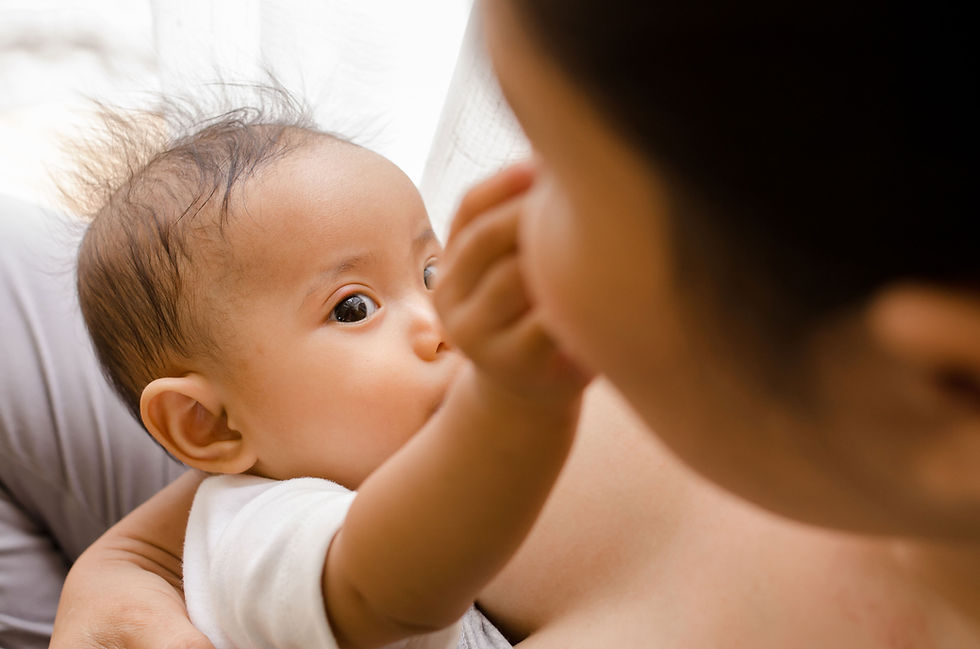
What Communication Looks Like at Six to Eight Weeks
At six to eight weeks, most babies do three things that change everything:
They hold eye contact. Not the random, unfocused gaze of a newborn. Deliberate, sustained eye contact — your baby looking at you, recognizing your face, and staying there.
They begin to coo. Soft vowel sounds — "ooh," "aah" — the earliest vocal experiments your baby makes beyond crying. The Centers for Disease Control and Prevention (CDC) lists making sounds other than crying as a key two-month communication milestone (https://www.cdc.gov/act-early/milestones/2-months.html).
The social smile emerges. This is not a gas bubble. This is your baby smiling at you — because you smiled first, because you walked in the room, because they are happy to see you. Research published in PubMed documented this exact developmental trajectory: by the end of the second month, infants shift from simple attention to active, emotionally positive communication — a complex weave of concentrated attention, smiling, and cooing directed at their caregiver. Freedman, D.G. et al. Developmental changes in the relationship between the infant's attention and emotion during early face-to-face communication: the 2-month transition. PubMed, National Library of Medicine. https://pubmed.ncbi.nlm.nih.gov/15656754/
These three behaviors — eye contact, cooing, and the social smile — are not cute extras. They are the foundation of language.
Why These Early Moments Matter So Much
Here is the part that matters most for parents to understand:
Communication doesn't start with words. It starts with connection.
Every time your baby holds your gaze, they are practicing the back-and-forth rhythm of conversation. Every coo they make — and every time you coo back — builds the neural pathways that will eventually carry language. Researchers at the National Institutes of Health have described this as "serve and return": your baby serves a sound or look, and you return it. That exchange wires the brain for language development (https://pmc.ncbi.nlm.nih.gov/articles/PMC7055680/).
When those early communication behaviors are not developing — when eye contact is minimal, when cooing is absent, when the social smile doesn't arrive — that is the earliest signal we have that something may be worth watching. A PubMed study on early social communication found that deficits in eye contact were among the most recurring and predictive early markers of later communication and developmental differences, observable as early as 12 months — which means the roots of that finding go back even further, into those first weeks of life. Wetherby, A.M. et al. Early markers of autism spectrum disorders in infants and toddlers prospectively identified in the Social Attention and Communication Study. PubMed, National Library of Medicine. https://pubmed.ncbi.nlm.nih.gov/22735682/
And research in the Journal of Speech, Language, and Hearing Research found that prelinguistic communication behaviors in toddlers — those preverbal looks, sounds, and gestures — directly predict expressive and receptive language outcomes 12 months later. Calandrella, A.M. et al. Predicting language outcomes for young prelinguistic children with developmental delay. PubMed, National Library of Medicine. https://pubmed.ncbi.nlm.nih.gov/11063230/
What happens at six to eight weeks ripples all the way to toddlerhood.
It's Not Your Fault That Nobody Told You This
Parents aren't asking "When do babies start talking?" at the wrong time because they aren't paying attention. They're asking at the wrong time because nobody ever taught them when to start noticing.
The standard system hands you a newborn and a pamphlet. You go to well-child visits at two weeks, two months, four months — and unless something is visibly wrong, you are usually told everything looks fine.
Nobody sits down with you and says: "Watch for cooing by six to eight weeks. Watch for the social smile. Watch for your baby holding your gaze — because these are the first words your baby will ever say, and they don't sound like words at all."
That's not a failure of love on your pediatrician's part. It's a gap in the system.
That gap is exactly what NewDay Child Coaching™ was built to fill.
From Worry and Wonder to Confidence and Clarity
The PATHWise™ quiz — envisioned by Rachel Lynn May, MA, CCC-SLP and built by the Trinamic Trio™ — asks parents two things: what you are noticing in your child, and how you feel about supporting each area of development. Because you are not just observing your baby. You are part of their journey.
The newborn quiz is almost here. Month-by-month quizzes are being created now and will be available soon.
Because parents deserve more than "wait and see."
They deserve to know what to look for, when to look for it, and what to do with what they find.
👉 Take the free PATHWise™ quiz: https://www.newdaychildcoaching.com
(Quiz coming very soon — join the NewDawns™ community so you're the first to know.)
Frequently Asked Questions
When do babies start communicating? Most babies begin communicating as early as six to eight weeks of age — through sustained eye contact, cooing sounds, and the social smile. These are the earliest building blocks of language development, long before a first word appears.
What are the first signs of communication in babies? The first signs of communication are social: holding eye contact, smiling in response to a caregiver's face or voice, and making soft vowel sounds (cooing). The CDC lists making sounds other than crying as a two-month language and communication milestone (https://www.cdc.gov/act-early/milestones/2-months.html).
When might I notice concerns about my baby's communication? These early communication behaviors are worth paying attention to from the start. When eye contact is limited, cooing is absent, or the social smile does not emerge by around six to twelve weeks, those observations are worth sharing with your child's pediatrician. Trusting what you notice as a parent is always the right move.
What is the PATHWise™ quiz? The PATHWise™ quiz is a free parent quiz envisioned by Rachel Lynn May, MA, CCC-SLP and built by the Trinamic Trio™. It asks two things: what you are noticing in your child, and how you feel about supporting each area of development. Month-by-month quizzes are coming soon.
Join the NewDawns™ Community
NewDawns™ are the families doing this work every day — watching, supporting, and advocating for their children with heart and intention. If you're ready to move from worry and wonder to confidence and clarity, you belong here.
👉 Join our free Facebook community: https://www.facebook.com/NewDayChildCoaching/
The content in this post is for informational and educational purposes only. It does not constitute advice, diagnosis, or treatment of any kind. The PATHWise™ framework was envisioned by Rachel Lynn May, MA, CCC-SLP and built by the Trinamic Trio™. Please consult a licensed professional for individualized guidance.
The concepts, knowledge, and original thought in this post are the sole intellectual property of Rachel Lynn May, MA CCC-SLP, and NewDay Child Coaching™.
©2026NewDay Child Coaching™ | Be The Catalyst International LLC. All rights reserved.


Comments